


TJ RAMADAN: Fasting
Showing posts with label Fasting. Show all posts
Showing posts with label Fasting. Show all posts
Exemption from Fasting Due to Sickness or Travel
Activity & Coloring Pages,
Fasting
25 May 2019

Observing Saum (fasts)] for a fixed number of days,
but if any of you is ill or on a journey,
the same number (should be made up) from other days.
And as for those who can fast with difficulty, (e.g. an old man, etc.),
they have (a choice either to fast or) to feed a Miskin (poor person) (for every day).
But whoever does good of his own accord,
it is better for him.
And that you fast,
it is better for you if only you know.
(2:184)
Sahoor Flipbook
Fasting,
Foldables & Notebooking,
Suhoor
02 May 2019
This foldable also appears under the Sahoor page but I gave it its own page here for anyone looking to browse foldables (which can be found using the Ramadan foldables tag.)
Sahoor Layered Flapbook Foldable (New 2019!)


Sahoor Layered Flapbook Foldable (New 2019!)


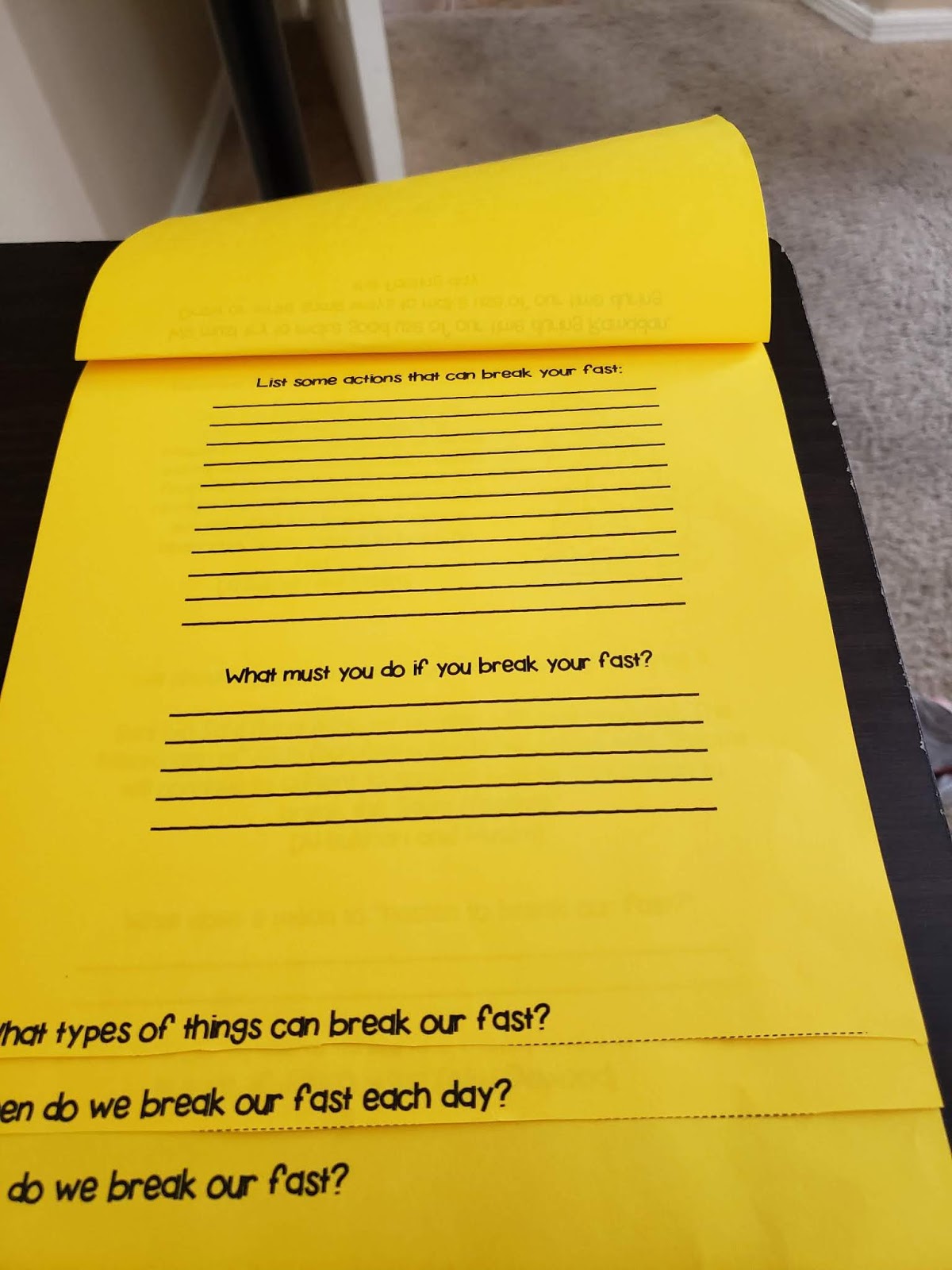
Fasting in Ramadan Tab book
Use this tab book foldable to help learn and review fasting during the month of Ramadan!




Imsak: The False Practice of Stopping Eating of Sahoor at a Predetermined Time

When we were living in Egypt in a small village, each morning we would hear a big drum booming out Imsak, that it was time to stop eating (about 10 minutes or so) before the adhaan was to be called.
Imsak is impermissible.
1. Stop eating Suhoor (Al-Imsak) 10-15 minutes earlier than the time of Fajr ? – Shaykh ibn Uthaymeen
Al-Nawawi (may Allaah have mercy on him) said: "This shows that it is permissible to eat, drink, have intercourse etc until dawn comes."
Al-Haafiz ibn Hajar said in Fath al-Baari (4/199): "One of the reprehensible innovations that have appeared in our times is giving the second adhaan approximately twenty minutes before Fajr in Ramadaan, and extinguishing the lamps which indicate that it is haraam to eat and drink for those who want to fast. Those who introduced this innovation claim that they are erring on the side of caution with regard to an act of worship."
What is obligatory on all Muslims is that they hold on firmly to the Qur'an and Sunnah and follow it as closely as one can. This is a safeguard for us, so that we don't fall right or left but stay on the middle course. The Prophet (صلى الله عليه وسلم) described the religion of Islaam that is a middle course between extreme and lenient. Remember these words of the Prophet (صلى الله عليه وسلم): I leave behind me two things. You will never go astray if you hold fast to them: The Qur'an and my Sunnah.
O Allah! Render the thoughts and inclinations within my heart, to be Your fear and remembrance, and let my endeavour and desire be devoted to what You love and appreciate. Keep my feet firm on Thy Right Path so that I should not stagger, and guide me to the true Faith so that I should not go astray. Ameen!!!
Source : http://www.calgaryislam.com/imembers/displayarticle542.html (link no longer working)
For more about the practice of taking a sahoor (pre-dawn meal before fasting) as well as ideas for sahoor, see:my Sahoor post
All About Suhoor

(*The act of eating the pre-dawn meal is "suhoor." The actual meal that is eaten is "sahoor." (Source: Ramadhan Lessons 2019, Lesson 2))
The Prophet (salAllahu alaihi wa sallam) said, “Eat suhoor for in suhoor there is blessing.” and “Verily that which separates (i.e. distinguishes) between our fast and the fasting of the People of the Book (i.e. Jews and Christians) is the eating before dawn (Suhoor).” [Sahih al-Bukhari and Muslim]
Iftaar: Ending the Fast at Sunset

How Do We Know When to Break Our Fast?
`Umar bin Al-Khattab (May Allah be pleased with him) reported:The Messenger of Allah (sallallaahu alayhi wa sallam) said: “When the night approaches from this side (i.e., the east) and the day retreats from that side (i.e., west) and the sun sets, then it is time for a person observing Saum (fasting) to break his fast.”[Al-Bukhari and Muslim] (Source)
Hastening to Break the Fast
Sahl bin Sa`d (May Allah be pleased with him) reported:The Messenger of Allah (sallallaahu alayhi wa sallam) said, “People will continue to adhere to good as long as they hasten to break the Saum (fasting).”[Al-Bukhari and Muslim) (Source)
Abu Hurairah (May Allah be pleased with him) reported:
The Messenger of Allah (sallallaahu alayhi wa sallam) said, “Allah the Most High says: `From amongst my slaves, the quicker the one is in breaking the Saum (fasting), the dearer is he to me.”’[At-Tirmidhi] (Source)
Abu Atiyyah (May Allah be pleased with him) reported:
Masruq and I visited `Aishah (May Allah be pleased with her) and said: “O Mother of the Believers! There are two Companions of Muhammad (sallallaahu alayhi wa sallam) and neither of them holds back from doing good acts; but one of them hastens to break Saum (fasting) and hastens to perform the Maghrib prayer, while the other delays breaking Saum and delays performing Salat (prayer).” She asked, “Who is the one who hastens to break Saum and perform the Maghrib prayer?” Masruq said, “It is `Abdullah (meaning `Abdullah bin Mas`ud).” She said, “The Messenger of Allah (sallallaahu alayhi wa sallam) used to do so.” [Muslim] (Source)
Hastening to Open the Fast - Abu Muadh Taqweem (quick benefit):
Hasten to break your fast & pray Maghrib Prayer in the Masjid – Shaykh al-Albaani
"He (صلى الله عليه و سلم) used to break the Fast with three dates. He would eat three dates. Then he would pray the Maghrib Prayer, then he would eat again if he found that he needed to eat the evening meal."
Doubt as to whether or not the sun has set (to break your fast)
Hastening to Break the Fast Worksheets
There are two versions; the first for younger kids and the second for a little older kids.


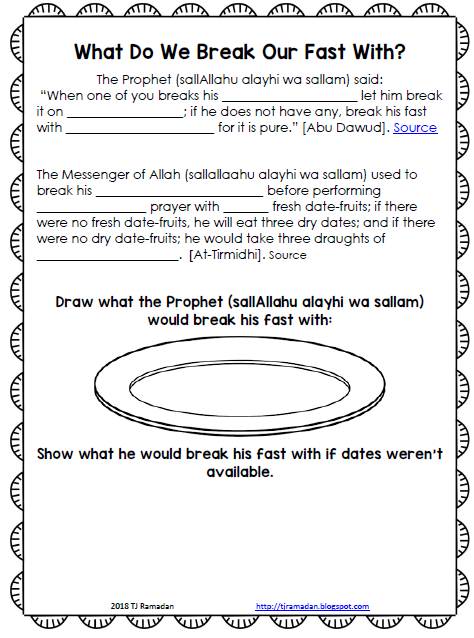
Breaking the Fast with Dates
Salman bin `Amir (May Allah be pleased with him) reported:I heard the Prophet (sallallaahu alayhi wa sallam) saying, “When one of you breaks his Saum (fasting), let him break it on dates; if he does not have any, break his fast with water for it is pure.” [Abu Dawud]. Source
Anas (May Allah be pleased with him) reported:
The Messenger of Allah (sallallaahu alayhi wa sallam) used to break his Saum (fasting) before performing Maghrib prayer with three fresh date-fruits; if there were no fresh date-fruits, he will eat three dry dates; and if there were no dry date-fruits; he would take three draughts of water. [At-Tirmidhi]. Source
What Do We Break Our Fast With?
Supplication for Breaking the Fast
"The supplication which is reported from the Prophet sallAllaahu ‘alayhi wa sallam is:
اللهم لك صمت و على رزقك أفطرت
(Allaahumma Laka Sumtu Wa ‘Ala Rizqika Aftartu.)“Oh, Allaah! For Your sake I have fasted and with Your sustenance I have broken my fast.”
ذهب الظمأُ، وابتلت الروق و ثبت الأجر إن شاء الله
(Thahabath-Thama’u Wabtallatil-‘Urooqu Wa Thabatal-Ajru In Sha’ Allaah.)“Thirst has gone, the arteries are moist, and the reward is sure, if Allaah wills.”
Although there may be some weakness in these two ahadith, some of the Scholars have declared them to be Hasan; and in any case, if you supplicated using these words or any others words that came to your heart when breaking your fast, then it is most likely to be answered."
Source: Supplications Upon Breaking the Fast & Responding to the Mu’aththin – Shaykh Muhammad bin Saalih al-Uthaymeen
Color coded to help learn the vocabulary of these duaas.

Feeding the One Breaking His/Her Fast
The Messenger of Allaah (salallaahu ‘alaihi wa sallam) said,
“Whoever feeds a fasting person will have a reward like that of the fasting person, without any reduction in his reward.” [At-Tirmidhi, authenticated by Al-Albani (rahimahullaah).]Shaykh Muhammad bin Saalih Al-‘Uthaimeen (rahimahullaah) said,
“Those who have the ability should strive to feed those who are fasting (when it’s time to break the fast) either in the masaajid or in other places. This is since whoever feeds a fasting person, he will receive the same reward as the one fasting. So if a person feeds his brothers who are fasting, he will receive the same reward as them. Therefore, those whom Allaah has granted wealth should take advantage of this opportunity to obtain a great reward.”From: Great Reward of feeding a Fasting Person to Break his Fast – Dr. Saleh as Saleh
Breaking the Fast in Someone's Home
When you are breaking your fast in someone's home, you can say this duaa:
أَفْطَرَ عِنْدَكُم الصّائِمونَ وَأَكَلَ طَعامَكُمُ الأبْرار، وَصَلَّتْ عَلَيْكُمُ الملائِكَة
Aftara ‘indakumus-saa’imoona, wa ‘akala ta’aamakumul-‘abraaru, wa sallat ‘alaykumul-malaa’ikatu
With you, those who are fasting have broken their fast, you have fed those who are righteous, and the angels recite their prayers upon you. (Source)
Praying Maghrib BEFORE eating dinner
Error: Partaking of Dinner before the Performance of the Maghrib Prayer #Ramadan pic.twitter.com/RSwV866CDY— troid.org (@troidorg) April 24, 2020
The Command to Fast
Fasting
01 April 2018

Ayaah 2:183-185 tell us about Allah's command to fast the month of Ramadan.
“O you who believe! Fasting is prescribed for you, as it was prescribed for those before you so that you will gain piety” (2:183)Observing Saum (fasts)] for a fixed number of days, but if any of you is ill or on a journey, the same number (should be made up) from other days. And as for those who can fast with difficulty, (e.g. an old man, etc.), they have (a choice either to fast or) to feed a Miskin (poor person) (for every day). But whoever does good of his own accord, it is better for him. And that you fast, it is better for you if only you know. (2:184)
The month of Ramadan in which was revealed the Quran, a guidance for mankind and clear proofs for the guidance and the criterion (between right and wrong). So whoever of you sights (the crescent on the first night of) the month (of Ramadan i.e. is present at his home), he must observe Saum (fasts) that month, and whoever is ill or on a journey, the same number [of days which one did not observe Saum (fasts) must be made up] from other days. Allah intends for you ease, and He does not want to make things difficult for you. (He wants that you) must complete the same number (of days), and that you must magnify Allah [i.e. to say Takbir (Allahu-Akbar; Allah is the Most Great) on seeing the crescent of the months of Ramadan and Shawwal] for having guided you so that you may be grateful to Him. (2:185)
Below are some resources to use when teaching about why we fast the month of Ramadan.
The Command to Fast Ayaat Poster: Poster of the ayaat of the Quraan in which Allah prescribes fasting the month of Ramadan


Ayaah 2:183-185 at Quran.com (Arabic text, English translation, audio)
Fasting Six Days of Shawwaal
After Ramadan,
Fasting,
Shawwaal
25 June 2017

Abu Ayyoub reported that the Messenger of Allah, salla Allahu alaihi wa sallam said:
Whoever fasts the month of Ramadhan and then follows it by fasting six days during the month of Shawwal will be rewarded as if he had fasted the entire yearFasting Six Days of Shawwaal - (The ClearSunnah.Blog)
The reward of fasting the six days of Shawwaal, the manner of observing this voluntary fast
Excerpts:
Fasting the six (days) of Shawwaal is a recommended act of worship and not an obligation. It is not a must for him to fast immediately after ‘eed al-fitr, rather it is permissible to begin fasting after ‘eed by a day or (a number of) days. And (also) to fast them continuously or intermittently in the month of Shawwaal according to that which is easy for him."
And the issue is quite open in this matter, and it is not obligatory, rather it is a sunnah. These days can be anytime during the month of Shawwal except the first day because it is unlawful to fast the day of Eid. These days do not have to be at beginning of the month nor do they have to be consecutive.
Hence, Muslims should seize this opportunity and fast these six days to get Allah’s reward."He should not do the voluntary fast whilst he has a day or days to make up from Ramadhaan. Rather, he should begin by making up that which he has (outstanding) from Ramadhaan, then do the voluntary fast.

Hence, Muslims should seize this opportunity and fast these six days to get Allah’s reward."He should not do the voluntary fast whilst he has a day or days to make up from Ramadhaan. Rather, he should begin by making up that which he has (outstanding) from Ramadhaan, then do the voluntary fast.
When to Fast the Six Days of Shawwaal
Must the six days of Shawwal be fasted directly after Eid day?It is not necessary to observe this Sawm directly after `Eid-ul-Fitr.It is permissible to start observing it one or more days afterwards.The six days can be observed either consecutively or non-consecutively during the month of Shawwal, whichever is easier.This matter is open to choice, as this Sawm is Sunnah and not Faridah (obligatory act). May Allah grant us success.
For those who have asked me: It is allowed to fast either to make up days of Ramadhaan or to start the 6 days of Shawwaal starting tomorrow (Friday), as the only day when fasting is prohibited these days is the actual day of 'Eid al-Fitr alone. It is not a 3-day 'Eid to be clear.
— Moosaa Richardson (@1MMeducation) May 13, 2021
Fasting Six Days of Shawwaal While Still Having Ramadan Fasts to Make Up
- Priority to make up for missed days of Ramadan over fasting the six days of Shawwal (Al Ifta via AbdurRahman.org)
- Can We Combine Ramadhan Make-ups with the Six Shawwal Fasts? (Response from Shaykh Al- Albaani
- Fasting Shawwal When One has days to Make up from Ramadhaan - Shaykh Muqbil
- Fasting the six days of Shawwal while still having to make up fasts
- Fasting the six days of Shawwal after the month of Shawwal has ended
Voluntary Fasting
Voluntary Fasting in Islam - Salafi Publications
Fasting in general and voluntary fasting in particular is a great worship of all time. Fasting is not restricted to Ramadhan, it is an act of worship that can be [and should be in some cases] performed at any time and at any place except when not recommended. Indeed, it is a worship that draws the believer closer to Allah and closer to perfection.
Printables
Fasting Other Than Ramadan
What Breaks the Fast?
Fasting
10 March 2017
Sh. Uthaymeen: It is not permissible to claim that anything breaks the fast, unless there is evidence to support that claim from the Quran, the Sunnah, Consensus (الإجماع), or a Sound Analogy (القِياس الصحيح). [1]— The Fiqh Corner (@thefiqhcorner) April 25, 2020
——
[1]: University Level Jurisprudence, vol. 2/ pg. 62.
Reference
Does it Break the Fast? (link updated 3/2025) - DuSunnah.com has a nice 2 page PDF that answers important questions about fasting and then includes a table with different actions and states whether or not those actions break the fast. (link updated 4/30/18)
The 8 types of things (mufattirāt) that break the fast of a person.
— Abu Muadh Taqweem (@AbuMuadhTaqweem) April 24, 2020
Short 3-mins clip - bitesize rulings.
Translated from Shaikh ibn ‘Uthaymīn رحمه الله
Listen here: https://t.co/o3TvnUW9n2
Worksheets & Activities
Does it Break the Fast? Worksheet - A simple worksheet for older students to complete (it contains mature subject matter)


Things That Break the Fast Mobile

You can download the Things that Break the Fast Mobile at Islamic Bulletin Boards!!!!!
Children and Fasting
Fasting
25 October 2015

Someone brought up the topic of children and fasting online and someone responded with great advice from Shaykh Ubaid Al-Jabiri, alhamdulillah, so I thought I would share it here as well as Ramadan draws near. In the question to the scholar below, someone asks about a woman who made her two year old fast. This brought to mind of an incident someone related to me about a woman in her home country of Morocco who had a little girl and made her fast and the girl repeatedly asked her mother for something to eat throughout the day, but the mother told her to just try to hold on a little longer, a little longer, and subhanAllah, later that day the little girl passed away as a result of the fasting.
Benefit: Chart - Who Fasting Is and Isn't Incumbent Upon
Training Children for Worship:
Al-Rubay’ bint Mu’awwidh – Allah be pleased with her – said while describing how the Prophet – Allah’s peace and blessings be upon him – told them to fast ‘Âshûrâ:
We used to make toys out of dyed wool for the children and keep them with us so if the children asked us for food we would give them the toys to distract them until they completed their fast. Sahîh Muslim. A similar narration is also in Sahîh Al-Bukhârî.
Al-Nawawî states in his commentary on Sahîh Muslim:
In this narration we are shown that children should be trained to do acts of obedience and made used to doing worship; although they are not legally bound.
Question:
Oh Shaykh, You find from the women those who make their child fast and the child is only two years of age. They use as a proof for this, that the Salaf used to make the young children fast. What are your comments upon this?
Answer by Shaykh Ubaid Al-Jabiri:
That which I am aware of from which the scholars have mentioned, is that the young child should be commanded to fast, if they are able to handle it. I believe that they intend by this the child who has reached the age of discretion (tamyeez) or those above that, those who are (approx.) 8 or 9 years of age because they are said to be able to handle it. The child is commanded with acts of worship when he reaches the age of discretion. This is as training and to get him accustomed to it so he may know the acts of worship like the prayer and fasting.
As for the woman making the child fast and they are two years of age then this is a mistake. I don’t know any example of this from the actions of the Salaf. I hope that you convey my Salaams to them. And I advise them to fear Allah as it pertains to their children. For, verily the child who is two will suffer harm from fasting and he has no intellect to allow him to be commanded. That which is reported upon the Salaf is that the child should be commanded, and the like of him, (the two year old) will not be able to comprehend a command or prohibition. Those women making their children (the like of this age) fast are committing a monstrous mistake.
I fear that if the baby was to die, due to the mother making him fast, she caused this and no doubt she is a sinner. I hold that she caused this and she has to pay blood money and “Kafarah” expiation.
Shaykh Ubaid Al-Jabiri
Related:
Lessons on Fasting for Kids- Fasting in Ramadan for Kids - lessons for kids from Authentic-Translations.com" - This article contains translations in very simple English and thus is intended for younger readers or anyone simply wanting a smooth reading article."
Teaching Kids to Fast
from “Fasting in Ramadan”
Children (who have not reached puberty) are not commanded to fast. However, they are strongly encouraged to fast even a few days so that they get used to it and they grow up knowing the worship of fasting. In fact this was the practise of the first women of lslam who were living around the Prophet, (Peace and Blessing of Allah be upon him). An example of that is Ar-Rubayya' bint Mu'awiyyah who reported that: "The Messenger of Allah, (Peace and Blessing
"Whoever has spent the morning fasting is to complete his fast.
Whoever has not spent this morning fasting should voluntary fast for the remainder of the day.' We fasted after that announcement, as did our young children, we would go to the mosque and make toys stuffed with cotton for them to play with. lf one of them started crying due to hunger, we would give them a toy to play with until it was time to eat." (Bukhari and Muslim.)
There are many ways to educate your children about Ramadan, the best and most important of which is to set a good example by fasting properly and behaving according to the Prophetic teachings. This is what your children will take from you first. When you are fulfilling this you can very easily [and they will accept it and practise it easily as well] teach them what you want. Here are a few guidelines that you can use with your children [you can think of others as well]:
1. Depending on their age encourage them to fast a number of days up to every other day or more for those who are almost at the age of puberty. For those who are still young let them fast a day or two.
2. Take your children to the Masjid for Maghrib prayer and break the fast with the larger Muslim community to make them feel the greatness of fasting and the unity of Muslims in worshipping Allah.
3. If your children cannot fast let them eat with you at the time of Maghrib and teach them that you are breaking the fast even if they ate before.
4. Teach your children the supplication of breaking the fast.
5. Take your children to the Taraweeh prayer so that they get used it and know about it from an early age.
6. Teach them to recite the Qur'an regularly and inform them that the Prophet (Peace and Blessing of Allah be upon him) used to do that in Ramadan.
7. Correct them if they misbehave or say unacceptable words and remind them that they are fasting and this may alter their reward.
8. Wake them up for Suhoor [even if they don't fast] and Fajr prayer.
9. Teach them to feed people who are fasting and tell them about the reward for that.
10.Dress them in the best clothes, give them a bath and take them with you to the Eid Prayer. Teach them that this is our celebration.
And remember that the Prophet (Peace and Blessing if Allah be upon him) said:
"One who is given the responsibility of bringing up Daughters and treats them well will be shielded from Hell. (Bukhari and Muslim)

Rulings for Fasting Specific to Women
Fasting
25 July 2011

Rulings for Fasting Specific to Women
Author: Shaikh Saalih Al-FawzaanSource: Abdur Rahman.org
Fasting the month of Ramadaan is an obligation on every male and female Muslim, and it is one of the pillars and great foundations of Islaam. Allaah says: "O you who believe! Fasting is prescribed for you as it was prescribed for those before you in order that you may attain Taqwaa." [Surah Al-Baqarah: 183] The word"kutiba" (prescribed) here means "furida" obligated. So when the young girl reaches the age in which she will be held accountable for her actions, by having one of the signs of puberty become apparent in her, among which is menstruation, then the obligation of fasting begins for her. She could begin menstruating as early as when she is nine years old. However, some young girls are not aware that they are required to begin fasting at that point, so she doesn’t fast thinking that she is too young, nor do her parents order her to fast. This is a great negligence, for one of the pillars of Islaam is being abandoned. If this occurs to any woman, she is obligated to make up for the days of fasting that she abandoned since the point when she began menstruating, even if a long time has passed since that time, for it remains in her obligations.
Who is obligated to fast Ramadaan?
When the month of Ramadaan comes, every male and female Muslim that (1) has reached the age of puberty, is (2) healthy and (3) a resident (i.e. not traveling) is obligated to fast. And whoever is sick or traveling during the month, may break the fast and make up the number of days missed on other days. Allaah says: "So whoever sights the (moon indicating the beginning of the) month, then he must fast. And whoever is sick or on a journey, then (he may break the fast and instead fast) the number of days missed on other days." [Surah Al-Baqarah: 185] Likewise, whoever enters into Ramadaan and he is very old and not able to fast or has a chronic illness, which does not expect to be cured any specific time - whether male or female - may break the fast and instead feed a needy person half a saa’ (four handfuls) of the food from that people’s land for every day missed. Allaah says: "And as for those who can fast (but) with difficulty, they (may break their fast and) feed a needy person." [Surah Al-Baqarah: 184] Ibn ‘Abbaas (raa) said: "This ayah is for the old man of whom it is not anticipated that he will be cured." [Saheeh Al-Bukhaaree] And the sick person of whom it is not hoped that he will be cured from his sickness falls under the ruling of the old person. And he does not have to make up the missed days because of his inability to fast.
A woman is specified with certain excuses that permit her to break the fast in Ramadaan, on the condition that she makes up the days she missed fasting due to these excuses on other days. These excuses are:
1. Menstrual and Postpartum Bleeding: A woman is forbidden from fasting while she is in these two conditions. And she is obligated to make up these missed days of fasting on other days. This is based on what is reported in the two Saheeh collections from ‘Aa’isha (raa) who said: "We were ordered to make up the (missed) days of fasting but we were not ordered to make up the (missed) prayers." She gave this answer when a woman asked her: "Why does a menstruating woman have to make up the (missed days of) fasting and not have to make up the (missed) prayers?" So she (raa) clarified that this is from the matters dependent on revelation, which must comply with the reported texts.
As for the wisdom behind that, then Shaikh-ul-Islaam Ibn Taimiyyah said in "Majmoo’-ul-Fataawaa" (15/251): "The blood that comes out of the woman because of menstruation has a discharge of blood in it. A menstruating woman can fast in times other than when the blood that comes out of her due to menstruation contains her blood. So her fasting in this situation is a moderate and balanced fast - no blood, which strengthens the body and which is its main substance - comes out of her during these times. But her fasting when she is menstruating necessitates that her blood come out during this time - the blood, which is the main component of her body and which will lead to a weakness and deficiency in her body. And this will necessitate that her fast not be that of a moderate and balanced nature. So that is why she is commanded to fast in times when she is not menstruating."
2. Pregnancy and Breast-Feeding: If because of fasting there is harm caused to the woman or the baby or to both of them, then she may break the fast while she is pregnant or breastfeeding. But if the harm for which reason she is breaking her fast only applies to her baby and not her, then she must make up for the days she missed of fasting and feed a needy person for each day missed. And if the harm only applies to herself, then it is sufficient for her to only make up the missed days. This is based on the pregnant woman and breastfeeding woman falling under the generality of Allaah’s saying: "And for those who can fast (but) with difficulty, they (may break their fast) and instead feed a needy person." [Surah Al-Baqarah: 184]
Al-Haafidh Ibn Katheer (rahimahullaah) said in his Tafseer (1/379): "Amongst those who fall into the meaning of this ayah are the pregnant and breastfeeding women if they fear for themselves or for their children." And Shaikh-ul-Islaam Ibn Taimiyyah said: "If a pregnant woman fears for her fetus, then she may not fast and instead make up each day of fasting that was missed on other days and feed a needy person around 2 kilograms of bread." [Majmoo’-ul-Fatawaa: 25/318]
Important Notes:
1. Istihaadah (Irregular Bleeding): This is the condition in which a woman has blood come out of her, which is not her menstrual blood. She must observe the fast and it is not permissible for her to break her fast because of this type of bleeding. When mentioning the allowance of the menstruating woman of breaking her fast, Shaikh-ul-Islaam Ibn Taimiyyah (rahimahullaah) said: "This is contrary to the woman in the state of Istihaadah, for this state comprises an unfixed period of time, and there is not a time in it in which she can be commanded to begin fasting (again). So because of this, it is not possible to caution against it, the same as for throwing up unexpectedly, emitting blood due to a wound, getting a boil, Ihtilaam (when sexual fluid comes out of the private parts not due to intercourse or foreplay), as well as all the other things that do not have a fixed time in which they could be cautioned against. So this (Istihaadah) was not made as something that nullifies the fast, such as the blood of menstruation." [Majmoo’-ul-Fataawaa: 25/251]
2. The Menstruating woman as well as the pregnant and breastfeeding women, if they break their fast in Ramadaan, must make up for the missed days of fasting in the time that occurs between the Ramadaan in which they broke their fast and the forthcoming Ramadaan. But to complete them early is better. And if there only remain a few days before the next Ramadaan begins, then they are obligated to make up the missed days of fasting (from the previous Ramadaan) such that the new Ramadaan will not come upon them while they still have to fast days from the previous Ramadaan. But if they don’t do this and Ramadaan comes upon them while they still owe days of fasting from the previous Ramadaan, and they have no (valid) excuse for delaying it, they are obligated to make up the missed days and to feed a needy person for each day. But if they have a valid excuse, then they must only make up the missed days of fasting. This goes the same for those who must make up the missed days of fasting due to sickness or traveling. Their ruling is like the ruling of the woman who broke the fast due to menses, with the previously mentioned details.
3. It is not permissible for a woman to observe a recommended fast if her husband is present unless she has his permission. This is based on what Al-Bukhaaree, Muslim and others have reported from Abu Hurairah (raa) that the Prophet (saws) said: "It is not permissible for a woman to fast while her husband is present except with his permission." In some narrations of the hadeeth in Ahmad and Abu Dawood, there occurs the wording "...except Ramadaan." But if the husband permits her to observe a recommended fast or he is not present around her or if she doesn’t have a husband, then it is encouraged for her to observe this recommended day of fasting. This is especially for the days in which it is recommended to fast such as Mondays and Thursdays, three days in every month, six days in Shawaal, the tenth day of Dhul-Hijjah, the Day of ‘Arafah and the Day of ‘Aashooraa along with the day before or after it. However, she should not observe a recommended fast while she owes days to make up for (the previous) Ramadaan, until she first makes up these missed days and Allaah knows best.
4. If a menstruating woman stops bleeding during the day in Ramadaan, she must begin her fasting for the remainder of the day but still make it up with the days that she didn’t fast because of menses. Her fasting for the remainder of the day in which she stops bleeding is an obligation on her out of respect for the time (i.e. Ramadaan).
Subscribe to:
Comments (Atom)


